

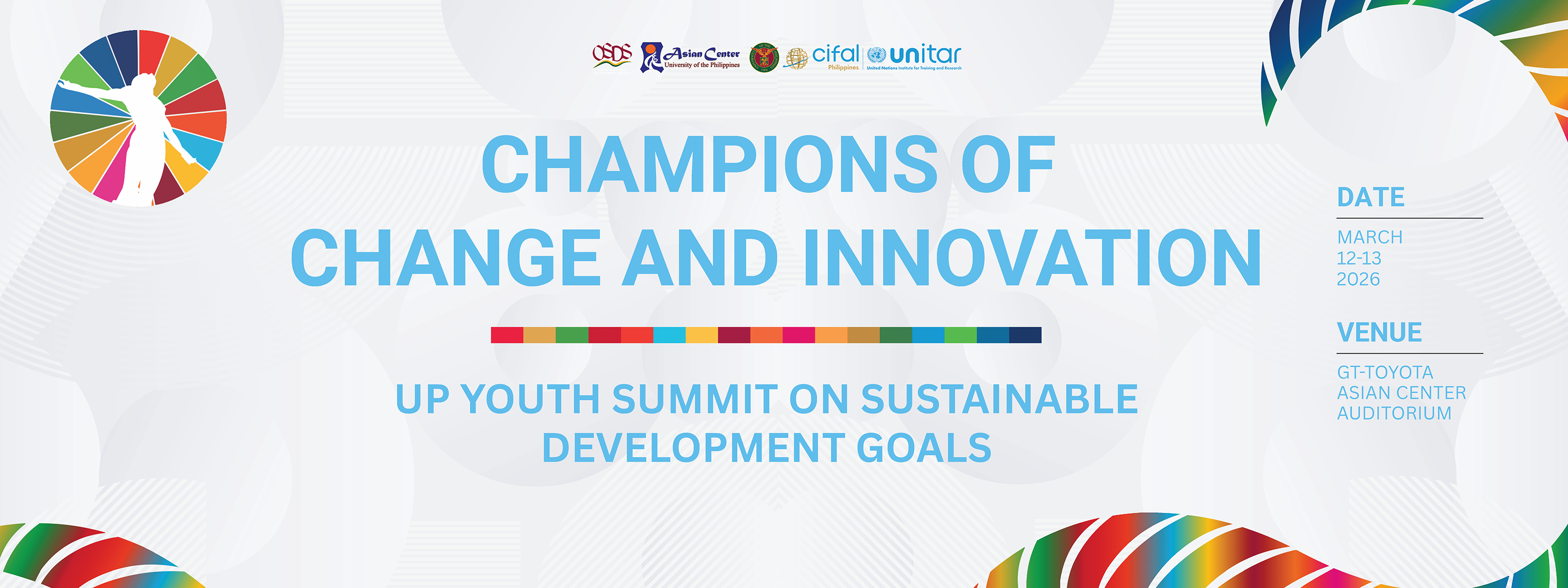
The University of the Philippines (UP) Office of the President, through the UP Office of the Vice President for Academic Affairs—Office of Student Development Services (OVPAA-OSDS), UP CIFAL Philippines, and the UP Asian Center will host the two-day capacity-building event for UP student leaders entitled "Champions of Change and Innovation: UP Youth Summit on Sustainable Development Goals."
ASK YOUR QUESTIONS HERE
ABOUT THE YOUTH SUMMIT
The United Nations Sustainable Development Goals (SDGs), adopted in 2015, are a global blueprint to achieve a better and more sustainable future for all. Young people—who account for over 1.2 billion globally—are both beneficiaries and essential partners in realizing the 2030 Agenda. More than one-third of SDG targets explicitly or implicitly reference youth, highlighting their role in empowerment, participation, and well-being.
In the Philippines, millions of young people have the potential to drive innovation, advocacy, and action toward sustainable development. Recognizing this, the University of the Philippines (UP) Office of the President, through the UP Office of the Vice President for Academic Affairs—Office of Student Development Services (OVPAA-OSDS), the UP CIFAL Philippines, and the UP Asian Center will host its very first SDG Youth Summit on 12-13 March 2026 at the GT-Toyota Asian Center Auditorium.
This two-day capacity-building event aims to enhance UP’s young leaders’ understanding of sustainable development, equip them with actionable skills, and foster collaboration among them in implementing grassroots projects in their own communities.
SDG Youth Summit Objectives
This two-day capacity-building event aims to enhance UP’s young leaders’ understanding of sustainable development, equip them with actionable skills, and foster collaboration among them in implementing grassroots projects in their own communities.
Specifically, this event aims to:
- Equip UP’s generation of young leaders with training, knowledge, and resources to advocate for and implement SDG-aligned initiatives in their communities, strengthening leadership, governance, and civic engagement.
- Deepen understanding of the SDGs, their relevance to youth work, and their integration into organizational mandates through lectures, discussions, and hands-on activities.
- Create an avenue for collaboration among UP student leaders from different constituent universities to exchange experiences from their communities and develop joint plans and strategies to push forward the UN SDG anchored to their needs.
- Celebrate Cultural Diversity and Artistic Expression. Highlight the role of arts and culture in promoting sustainable development and inspiring creative solutions.
- Produce a Concrete Action Plan. Ensure that participants leave the summit with well-structured SDG project proposals and commitments to implement them.
Why is it Relevant?
Do you know all the 17 SDGs?
Know more about the 17 UN Sustainable Development Goals, their history, and the progress of their implementation. Want to know the translation of the 17 SDGs into languages in the Philippines? Visit this folder! Don't forget to tag the UP OSDS, UP CIFAL Philippines, and Sentro ng Wikang Filipino - UP Diliman when you post on social media!
INFORMATION ABOUT THE YOUTH SUMMIT
Speakers and Special Guests
Meet the speakers and special guests who will be sharing their knowledge with us over the course of the summit! Resource speakers from diverse fields will bolster the learning experience and provide mentorship as participants develop their capstone projects.
Participating Student Organizations
This event aims to gather around 300 participants from various UP student councils and student organizations, in coordination with the Student Affairs offices of each Constituent Unit.
Rules and Guidelines of the Capstone Project
One of the Summit’s objectives is for participants to develop an actionable project that they will bring back to their community, in alignment with the University’s thrust of service to the people. Each CU will receive Php 50,000 in seed funding for one (1) capstone project, which must be completed within a one-year implementation timeline.
Schedule of Activities
The youth summit is a two-day capacity-building event that aims to enhance participants' understanding of sustainable development, equip young leaders from UP with actionable skills, and foster collaboration within their own communities. There will be three workshops to discuss an issue in their community, a potential actionable solution, and ways to refine their proposed project.

Speakers and Special Guests
Meet the speakers and special guests who will be sharing their knowledge with us over the course of the summit! Resource speakers from diverse fields will bolster the learning experience and provide mentorship as participants develop their capstone projects.
Participating Student Organizations
This event aims to gather around 300 participants from various UP student councils and student organizations, in coordination with the Student Affairs offices of each Constituent Unit.

Rules and Guidelines of the Capstone Project
One of the Summit’s objectives is for participants to develop an actionable project that they will bring back to their community, in alignment with the University’s thrust of service to the people. Each CU will receive Php 50,000 in seed funding for one (1) capstone project, which must be completed within a one-year implementation timeline.
Schedule of Activities
The youth summit is a two-day capacity-building event that aims to enhance participants' understanding of sustainable development, equip young leaders from UP with actionable skills, and foster collaboration within their own communities. There will be three workshops to discuss an issue in their community, a potential actionable solution, and ways to refine their proposed project.
FEEDBACK FORM
ABOUT THE VENUE
This event will be held at the GT-Toyota Asian Cultural Center Auditorium, University of the Philippines Diliman, Quezon City.
ABOUT THE ORGANIZERS
This event is organized by the UP Asian Center, the University of the Philippines (UP) Office of the President, through the UP Office of the Vice President for Academic Affairs—Office of Student Development Services (OVPAA-OSDS), and UP CIFAL Philippines.
UP Office of the President
The UP President is the Chief Academic Officer, Head of the University Faculty, and Chief Executive Officer of the University for a fixed term of 6 years. The President is expected to pursue goals stated in the UP Charter and pursue the Vision-Mission (which is later refined into a 6-year strategic development plan) s/he pledged to the community. Majority of the powers of the UP President are provided for in the UP Charter and determined by the Board of Regents as reflected in the Handbook on Existing Delineation of Authority in the University (2008).
UP Office of the Vice President for Academic Affairs
The Office of the Vice President for Academic Affairs (OVPAA) is the University of the Philippines System’s key academic support and implementation unit dedicated to achieving academic excellence, collegiality, ethical and democratic governance, international recognition, and a culture of creativity, research, and innovation towards the fulfillment of UP’s mission as the National University.
UP OVPAA - Office of Student Development Services

The Office of Student Development Services, under the Office of the Vice President for Academic Affairs, is the policy and coordinating body for student financial assistance and student welfare programs of the UP System. The responsibilities of the office include coordinating financial assistance services across the UP System, supervising the implementation of the UP System student insurance policy, organizing system-level student affairs meetings, and implementing other student support services and projects.
UP CIFAL Philippines
UP CIFAL Philippines was established in March 2016 through a cooperation agreement between the University of the Philippines and UNITAR. The center was formally launched during the 3rd Global Mayoral Forum in Quezon City on 29 September 2016. The center serves as a hub for training, advocacy, and research on the interwoven themes of the 2030 Agenda for Sustainable Development, migration, and gender equality.
Asian Center, University of the Philippines Diliman
The Asian Center is the University of the Philippines' only unit with a regional area of specialization and one of the colleges in the university's Diliman campus. Established in 1955 as the Institute of Asian Studies, the Asian Center offers graduate-level multidisciplinary programs on Asian Studies and on Philippine Studies.Its mandate—the study of Asia—is underpinned by law, Republic Act 5334, which took effect in June 1968. The Asian Center is based at the GT-Toyota Asian Cultural Center. It is a member of the Consortium for Southeast Asian Studies in Asia; the Kyoto International Consortium for Asian Studies (KICAS); and the Network of ASEAN-China Academic Institutes (NACAI).