

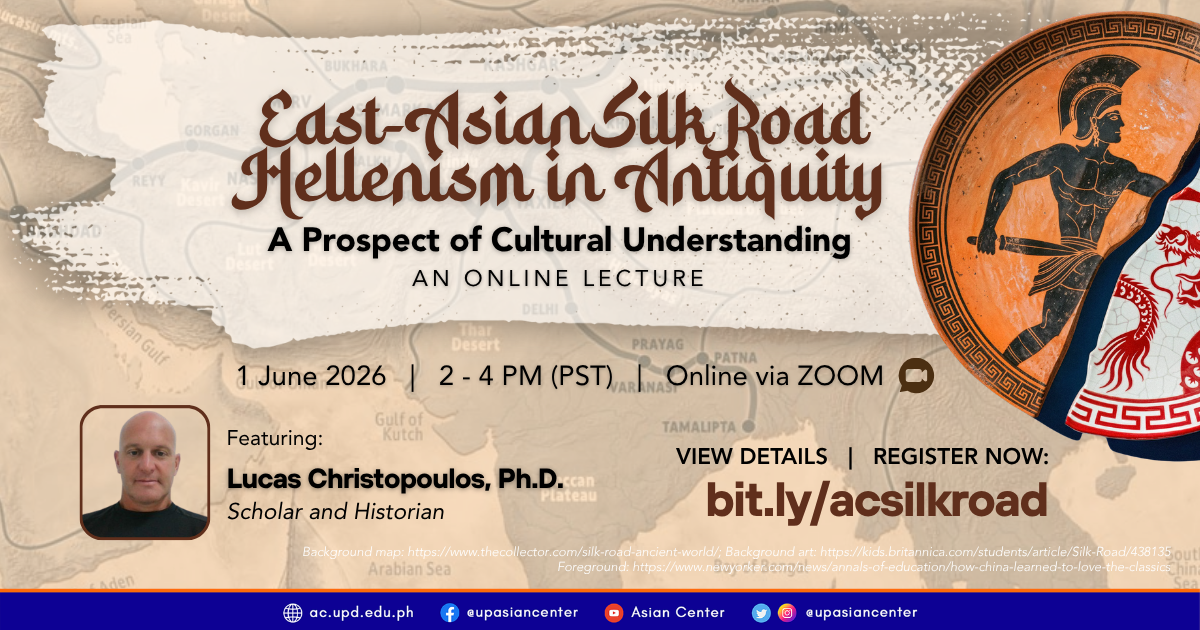
The UP Asian Center will be holding an online lecture on "East-Asian Silk Road Hellenism in Antiquity: A Prospect of Cultural Understanding" on 1 June 2026, at 2:00 PM, PHT (GMT+8) or 8:00 AM, CET, via Zoom. The event is free and open to the public, but signing in to a (free) Zoom account is required.
ABOUT THE LECTURE
The lecture will address two significant, yet often overlooked, periods of historical interaction during the Greco-Bactrian and Indo-Greek kingdoms. Spanning over three centuries, from Alexander's arrival in Central Asia (330–327 BCE) to the reign of the last Indo-Greek king, Strato III (25 BCE–10 CE) in Gandhara, this period marked profound cultural and philosophical exchanges. These interactions, which are often underemphasized in traditional historical narratives, played a pivotal role in shaping Hellenism together with other local East-Asian cultures.
The discussion will explore the lasting cultural fusion instigated by these kingdoms, and how the subsequent Kushan Empire preserved and institutionalized Indo-Greek cultural elements in its urban systems, religious practices, and societal structures. The speaker will examine two primary waves of cultural transmission. The first wave occurred during the Greco-Bactrian era and their interactions with the Qin Dynasty of China, particularly under the reigns of King Zhaoxiang and Ying Zheng (the first Emperor of China). This section will delve into the transformative influence of Hellenistic military strategies, warfare engineering, and the subsequent incorporation of Greek-influenced sculptural and architectural styles in the Qin Dynasty. It will also consider how Hellenistic ideas contributed to the religious and philosophical developments of the period, including the influence on Chthonic cults.
The second wave involves the Indo-Greek and Kushan kingdoms during the Western and Eastern Han, Wei and Tang Dynasties. A critical focus will be placed on the development of Greco-Buddhism—the fusion of Greek and Buddhist artistic traditions, philosophies, and myths—tracing their influence from Central Asia, Eastern Central Asia, to China and eventually Japan along the Silk Road. The spread of these cultural elements will be explored in relation to their long-term impact on East Asian artistic and religious thought.
Finally, the lecture will briefly address modern considerations of cultural understanding and the clash of civilizations. By revisiting these ancient interactions, he will propose that the cross-cultural exchanges of antiquity offer a valuable framework for resolving contemporary global conflicts, emphasizing how early civilizations, despite their geographic and cultural differences, found common ground in shared human experiences.
ABOUT THE SPEAKER
LUCAS CHRISTOPOULOS, Ph.D.
Scholar and Historian

Lucas Christopoulos is an internationally recognized scholar specializing in ancient civilizations, with a particular focus on the historical interactions between Greek and East Asian cultures. He obtained his Ph.D. in History from Hiroshima University, Japan, focusing on Hellenism in Chinese antiquity. His work examines the cultural exchanges that took place along the Silk Road, revealing how Hellenistic influences, including art, combat techniques, and religious symbols, became integrated into local traditions across Central Asia, Southeast Asia, India, China, and Japan. Christopoulos has also published numerous articles and papers that explore diverse topics such as Greco- Buddhist art, the influence of Greek combat sports, and syncretism between Greek and Chinese religious practices. Read more.
For inquiries, please contact us at This email address is being protected from spambots. You need JavaScript enabled to view it. or call 891-8500 loc. 3586.