

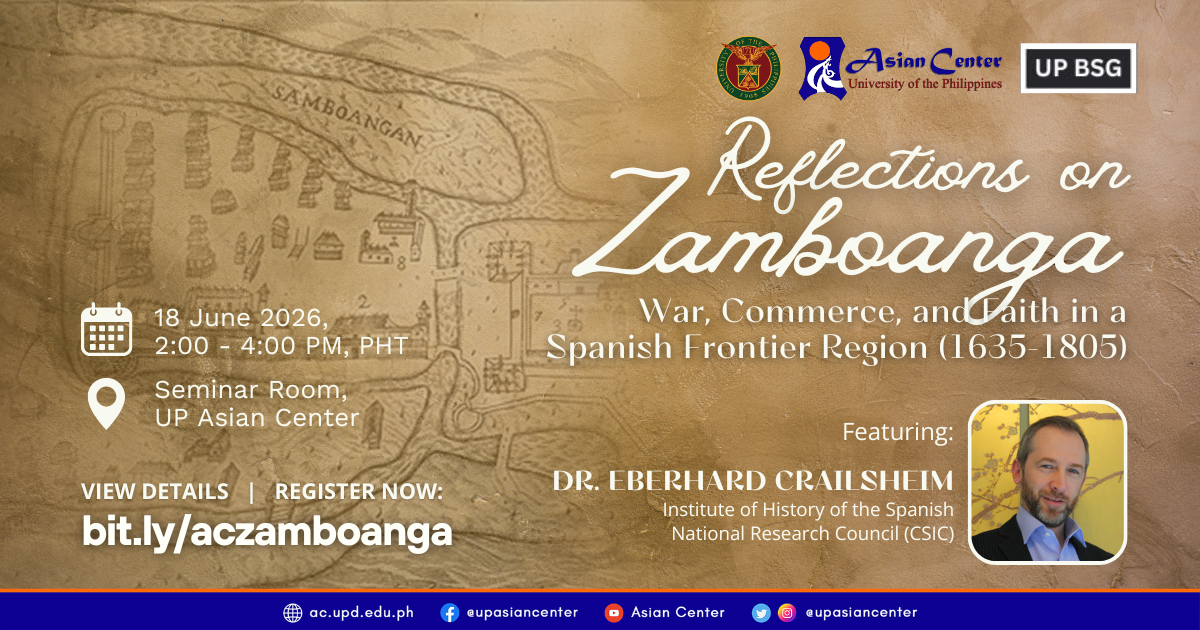
The UP Asian Center, in partnership with the UP Bangsamoro Studies Group, will be hosting an on-site lecture "Reflections on Zamboanga. War, commerce, and faith in a Spanish frontier region (1635-1805)" on 18 June 2026, from 2:00 to 4:00 PM, PHT (GMT+8) at the Seminar Room, Asian Center, UP Diliman. The event is free and open to the public. Online registration is encouraged due to limited slots.
ABOUT THE LECTURE
The Zamboanga Peninsula held significant geopolitical importance during the Spanish colonial period, serving as a frontier between the Islamic sultanates of Sulu and Maguindanao and Spanish-controlled territories. In 1635, the Spanish established the fortress of San José to restrict the movements and influence of these southern polities. From the seventeenth to the eighteenth centuries, Zamboanga became a contested yet dynamic space marked not only by military conflict but also by diplomacy, trade, and religious interactions. This paper situates Spanish intervention within broader regional dynamics, tracing key phases of conflict and accommodation while highlighting lesser-known instances of interethnic and interreligious coexistence between 1635 and 1805. It aims to contribute to a deeper understanding of early Islamic-Christian encounters and local agency in the Philippine past.
ABOUT THE SPEAKER
EBERHARD CRAILSHEIM, Ph.D.
Department of International and Global History, Instituto de Historia,
CSIC (Consejo Superior de Investigaciones Científicas-Spanish National Research Council),

Dr. Eberhard Crailsheim is a tenured researcher at the Institute of History of the Spanish National Research Council (CSIC) in Madrid, Spain. He received his Ph.D. from the University of Graz, Austria, completed postdoctoral work at the University of Hamburg, and has served as a visiting professor at the University of Hagen, Germany. Since 2016, he has been a member of the CSIC faculty, specializing in the Spanish presence in the Pacific, particularly the history of the Philippines during the 17th and 18th centuries. Crailsheim has edited and published several works on the diplomatic, commercial, cultural, and political history of the Spanish Empire. Among his works are a co-edited volume with Lola Elizalde, The Representation of External Threats: From the Middle Ages to the Modern World (Brill). His research focuses especially on the multifaceted contact zones in the southern Philippines, characterized by the complex and often fragile coexistence of Spaniards and the so‑called “moros,” a topic he has explored extensively in international journals and edited volumes. Additionally, he investigates the Austrian and German consular presence in the Philippines during the 19th century.
ABOUT THE REACTORS
MARIA CECILIA T. MEDINA, Ph.D.
Professor and TriCollege Coordinator, Asian Center, UP Diliman

Dr. Maria Cecilia T. Medina holds a bachelor’s degree in Sociology, Cum Laude, (1983), Master of Arts in Asian Studies (1991) both from the University of the Philippines. She obtained her doctoral degree in Sociology from Xavier University (2004). She has taught at the Department of Sociology, UP Diliman, Ateneo de Davao University and St. Paul University Quezon City. She was also a Fulbright scholar in a program on Religious Pluralism in the US and Public Presence at the University of California-Sta.Barbara in 2005. She is a Professor at the UP Asian Center, and an affiliate faculty of the UP Open University and Tri-College PhD Philippine Studies Program. She had previously served as the head of the secretariat and coordinator of the Tri-College PhD Philippine Studies Program and was Assistant to the Dean for Administration, Public and Cultural Affairs and editor of the college journal at the UP Asian Center. She is a regular member of the National Research Council of the Philippines, former Vice President, and presently on the board of the Philippine Sociological Society, currently a Board member of the Philippine Social Science Council, and member of the International Sociological Association. Her publications and research interests are on Asian religions and cultures, Indigenous Peoples and Ethnic relations, Disaster, and Southeast Asian Studies.
SHARIFUL HASHIM S. MANSUL
Senior Research Associate , UP Institute of Islamic Studies
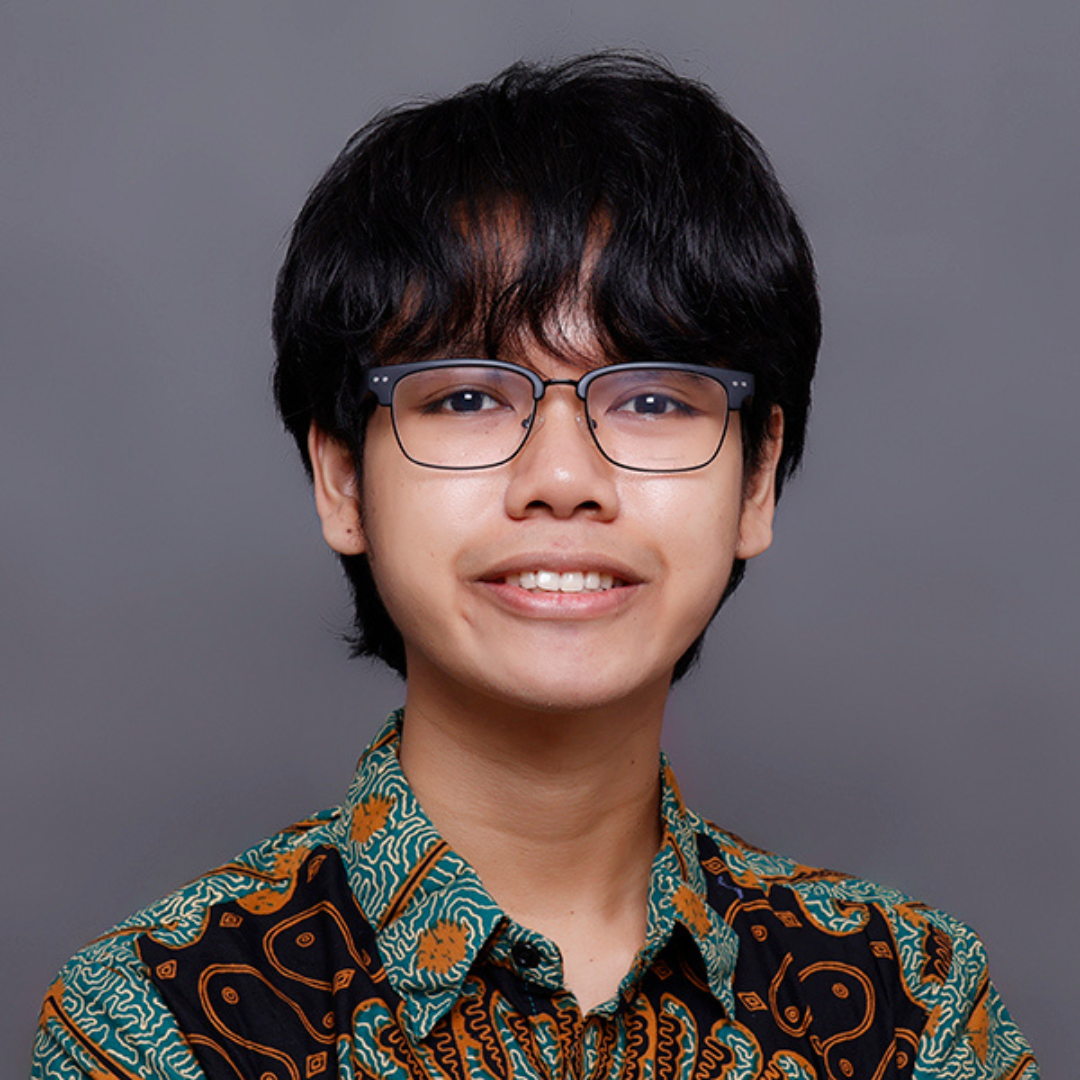
Shariful Hashim S. Mansul is a graduate student at the Asian Center taking up MA Philippine Studies. His research interests include Sulu Studies, maritime Southeast Asia, and decolonial theory. He is a founding officer of the UP Bangsamoro Studies Group, a student-led organization focused on the study and advocacy of the Bangsamoro in UP Diliman. He is also a Senior Research Associate at the UP Institute of Islamic Studies.
ABOUT THE ORGANIZERS
This lecture is organized by the UP Asian Center in partnership with the UP Bangsamoro Studies Group.
The UP Bangsamoro Studies Group is a student-led organization composed of individuals with strong interests in the Bangsamoro in the larger contexts of the Philippines, Southeast Asia, and the Global South under the guidance of Bangsamoro scholar Dr. Nassef Manabilang Adiong. Founded in 2024 by undergraduate, graduate, and law students in UP Diliman, the organization has since launched educational forums on different issues facing the Bangsamoro as an evolving political cause, rather than a static legal entity, and engaged in diverse partnerships with organizations and institutions within and beyond the University, such as the Bangsamoro Research and Legal Network (BRLN), MSU Tawi-Tawi, MSU Iligan, UP Padayon Public Service Office, and Dulaang UP. Learn more about the UP BSG.
For inquiries, please contact us atThis email address is being protected from spambots. You need JavaScript enabled to view it. or call 891-8500 loc. 3586.