

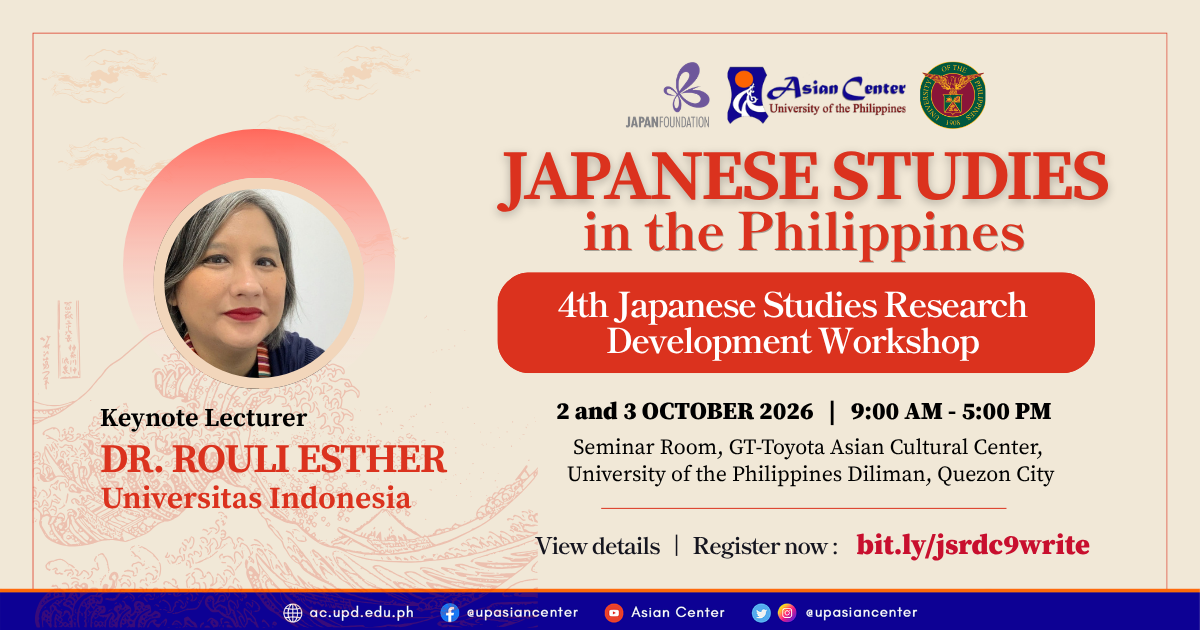
The UP Asian Center and the Japan Foundation Manila will hold the 4th Japanese Studies Research Development Workshop on 2 to 3 October 2026, 9:00 AM - 5:00 PM (GMT+8), ONSITE at the AC Galleries (ASEAN-Japan), GT-Toyota Asian Center, UP Diliman. The event is free and open to the public.
ABOUT THE KEYNOTE SPEAKER AND LECTURE
Representation of Women in Legends: Adaptation and Comparative Studies of Japan and Indonesia
Women are often portrayed as central characters in legends or folktales. This can also be observed in Japanese and Indonesian legends and folktales. In this presentation, I will introduce two studies I conducted in the past concerning the representation of women in legends.
The first is a comparative study of the recreation of legends in Komachi Hensoo by the Japanese female author Enchi Fumiko and Calon Arang: Kisah Perempuan Korban Patriarki by the Indonesian female author Toeti Heraty. This study found similarities in the patterns through which female authors recreate legends. The legends of Komachi and Calon Arang are stories that have circulated within Japanese and Indonesian societies and whose traditional narratives, when examined from a feminist perspective, position women as objects. Enchi Fumiko and Toeti Heraty recreate these legends in their own versions. In the versions created by Enchi Fumiko and Toeti Heraty, a common pattern can be observed: women become the central focus of the narratives.
The second is a comparative study of the representation of women's anger in two Japanese and Indonesian films based on legends, namely the horror film Tōkaidō Yotsuya Kaidan and the horror film Sundel Bolong. In both films, women are able to express their anger through revenge only after they move from the world of the living to the spirit world, taking the form of vengeful, wandering ghosts. Before becoming ghosts, however, they are unable to express their anger. This demonstrates how women are constructed as figures who are expected to remain obedient and not resist. Their resistance through the spirit world can therefore be read as reinforcing the perpetuation of patriarchal repression.
Reading from a Women’s Perspective: Feminist Literary Studies, Adaptation Studies, and Comparative Literary Studies
In conducting research on the recreation of the Komachi and Calon Arang legends and on the representation of women’s anger in the films Tookaidoo Yotsuya Kaidan and Sundel Bolong, the author employs several methodologies to analyse the texts. These methodologies are as follows.
First, feminist literary approaches are used to read cultural texts, adaptation studies are employed to examine the recreation of legends, and comparative literary studies are applied in the study of Japanese and Indonesian literature. In this presentation, I will introduce feminist approaches to reading cultural texts, particularly those developed by Susan Gubar and Sandra Gilbert, Barbara Creed’s concept of the monstrous feminine, and Carolyn Heilbrun’s concept of women’s anger. The author will also introduce Linda Hutcheon’s adaptation studies and comparative approaches to the study of Japanese and Indonesian literature. These three methodologies will be framed within the research framework of “Reading from a Women’s Perspective.”
ROULI ESTHER, Ph.D.
Assistant Professor, Universitas Indonesia

Dr. Rouli Esther is an assistant professor in the Japanese Studies Program, the East Asian Studies Postgraduate Program, and the Literary Studies Postgraduate Program at the Faculty of Humanities, Universitas Indonesia. She also serves as the Vice Dean for Academic, Research, and Student Affairs at the same faculty. She earned both her master’s and doctoral degrees from Osaka University, specializing in modern and contemporary Japanese women’s literature and gender studies. Her research interests include modern Japanese and Indonesian women’s literature, masculinities and femininities in Japanese popular culture, cultural exchange through the translation of Japanese literary works in Indonesia, and the image of Japan in Indonesia.
ABOUT THE LECTURERS AND THEIR PRESENTATIONS
A Thousand Winds and A Thousand Versions: Examining the Appropriative Power of Arai Mitsuru’s Sen no Kaze ni Natten
Is it possible for a derived text to outshine an original? In 2006, a Japanese song proved this possibility to be true. In that year, Akikawa Masufumi’s rendition of Arai Mitsuru’s (aka Arai Man) Sen no Kaze ni Natte topped the charts in Japan’s music industry. It continued to remain as the best-selling single in 2007, reaching 1,115,499 copies in sales. This statistical accomplishment is not only remarkable for the fact that it was Akikawa’s debut recording for what followed could only be called an artistic spawning of various musical covers by other artists, instrumental renditions, and choral arrangements. The artistic inflorescence or blooming of Sen no Kaze ni Natte illustrates the power of cultural appropriation. The lyrics of the song was based on a popular elegiac poem written by Clare Harner, which was published in 1934.
This haunting poem became the basis for Arai’s most uplifting composition, which in turn was appropriated by various artists of various genres, languages and cultures. Of particular note is Haley Westenra’s version titled A Thousand Winds. What are the sources of Sen no Kaze ni Natte’s appropriative power? What inspires better the uta ( 唄 ) that is the song or the uta ( 詩 ) that is the poem? Does the power rest in the double entendre that is the uta (歌) that is both the song and the poem? Is it the translatable nature of both textual composition of the poem and the musical composition of the song that allows for various interpretations and versions to emerge. Using methods gleaned from cyber ethnography, this research presents some answers found in the commentary sections of forums, blogs and chatrooms found in the Internet.
MATTHEW M. SANTAMARIA, Doctor of Law
Professor and UP Artist, Asian Center, UP Diliman
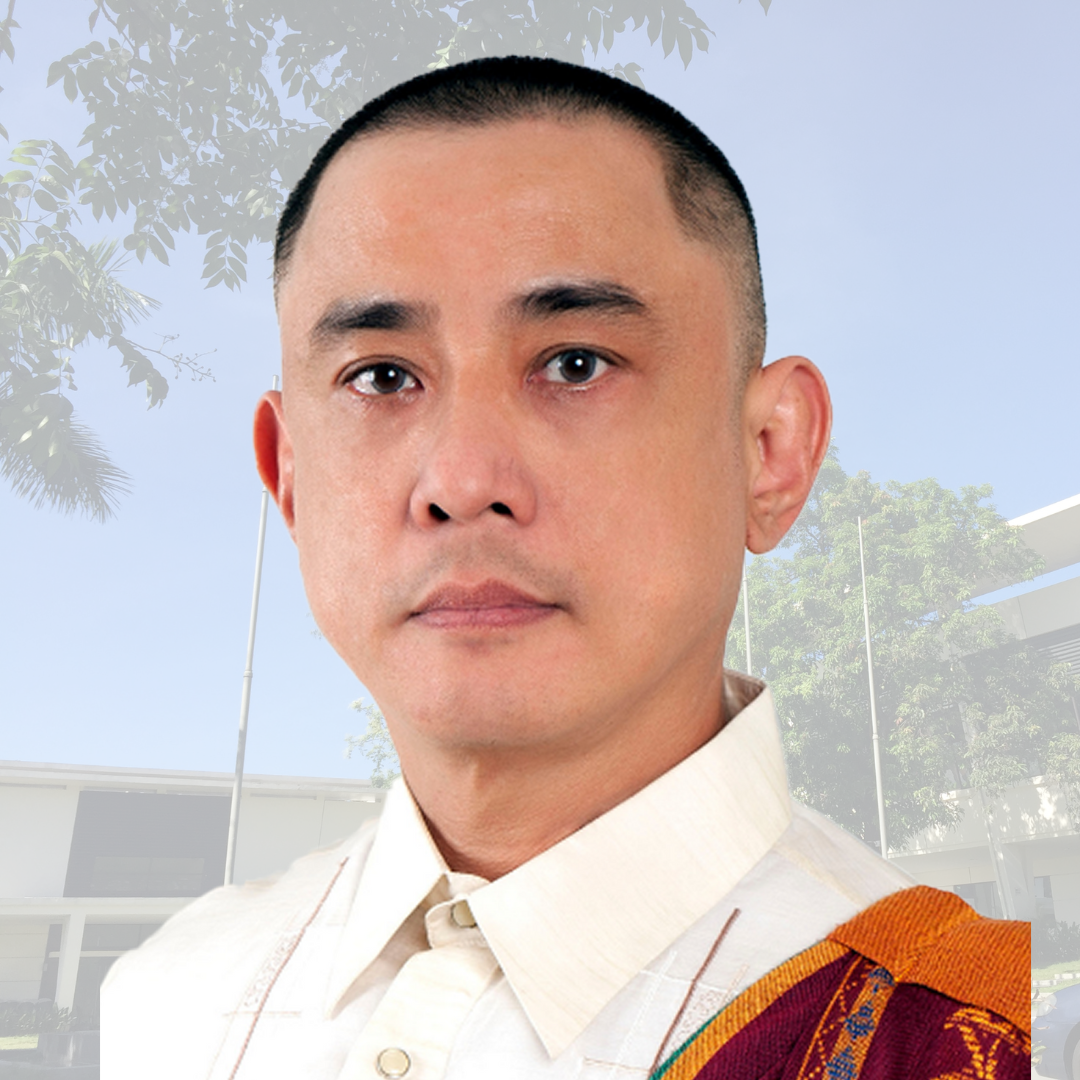
MCM (Matthew ConstancioMaglana) Santamaria is a Professor of Asian and Philippine Studies at the Asian Center, University of the Philippines Diliman. He received his Doctor of Law in Political Science from the Kyoto University Graduate School of Law in 1999. He holds the title of University of the Philippines Artist, and is also presentlya "One UP Professorial Chair" awardee. He has published many book chapters, articles and essays on the themes of ethnic conflict, Sama-Bajau ethnography, ritual and performance, and dance studies. Dr. Santamaria is also a practicing choreographer in the theatre arts. He has shown his choreographic works in Hanoi and NinhBinh, Vietnam; Honolulu and Lanai, Hawaii; Minsk, Belorussia; Phnom Penh, Cambodia; Shanghai, People’s Republic of China, Tainan and Taipei, Taiwan; and, Tokyo and Kyoto, Japan. He continues his advocacy in helping sustain Sama-Bajau traditional music and dance through the Bunga Arts Link (BAL), a performance group which he established in 2004. Through his work with the BAL, he has helped the Festival IgalAntarabangsa (FIA), a dance festival for the Sama-Bajau based in Semporna, Sabah, Malaysia. Through the BAL, he has also established the “Kulintangan Project,"a fund-raising endeavor for the purpose of purchasing kulintangan (graduated bossed-gong) music ensemble instruments for the Sama-Bajau diaspora communities in Luzon and the Visayas.
Leveraging on Infrastructure Development in Oda: Strengthening Strategic Alliances and Diplomatic Supremacy in Asia?
The new wave of development assistance in Asia produced differing variants of development tools--by types, forms, and even modality. It is believed that official development assistance has become more strategically placed in Asian countries, owing to the emerging roles that economies in the region may play, not only economically but also toward achieving security balance. Meanwhile, investing in infrastructure is one of the priorities of any State primarily to spur development benefiting its populace, but also to be competitive in a growing open market in the region. Japan as a donor country, leads in extending bilateral assistance in infrastructure to Asian countries as the growing importance of infrastructure being a catalyst for inter- and intra regional alliances has recently been recognized. The implicit nature of many of these alliances generated a new face of ODA that is driven by greater bilateral and multilateral motives. It is interesting to probe into how infrastructure development in Asia is achieving synergy through development assistance. An analysis is rendered on the contribution of infrastructure development to Asia’s growing influence as a region, and global player in achieving peace and stability. The ODA process reinforces diplomacy and economic ties, while serving as a strategic conduit for achieving greater regional goals.
ALEXANDER MICHAEL PALMA, Ph.D.
Assistant Professor, Asian Center, UP Diliman

Dr. Alexander Michael Palma is an Assistant Professor at the UP Asian Center. His research interests revolve around the field of development studies across a diversity of sectors to include, health, and nutrition, local governance, trade, social entrepreneurship, environment, public finance, project evaluation and monitoring, institutional economics, energy, urban and regional development to name a few. Dr. Palma devoted more than twenty years in development work having been engaged in projects for the United Nations, the World Bank, Japan International Cooperation Agency, the European Union, and Japan Bank for International Cooperation He has also been actively promoting the cause of health and nutrition ofchildren, trade and investment, public finance management, housing, education, civil identity and rights, infrastructure development among others. Dr. Palma contributed works in Japan studies, and received citation for the researches in the fields of local government and decentralization policy. Dr. Palma authored public finance studies at the Philippine Institute of Development Studies or PIDS. He conducted a review of the President’s budget, which involved the analysis of the utilization of the health appropriation.
Against Forgetting: Creative Forms of Protest Against the Gaza Conflict in Japan
The ongoing Gaza conflict is considered as the first major conflict of the 21st century based on the sheer number of casualties, particularly on the side of the Palestinians. The latest figures reveal that about 75,000 Palestinians -- many of them children -- have died in the past 3 years, and more than percent of the once thriving city has been destroyed. The Gaza conflict, which has come to the level of a genocidal war against Palestinians, has prompted international condemnation. While the Japanese government has not issued any official statement condemning the genocide, Japanese activists are part of the global solidarity against the Israeli government’s assault on Gaza, employing creative means in their protests including the use of literature, films, visual arts, and performance art. Guided by concepts borrowed from James Scott, Sarah Ahmed, and Deleuze and Guattari among others, the lecture will seek to illustrate the creative forms of protest being waged by various sectors of Japanese society against the genocide.
NOEL CHRISTIAN A. MORATILLA, Ph.D.
Dean and Professor, Asian Center, UP Diliman
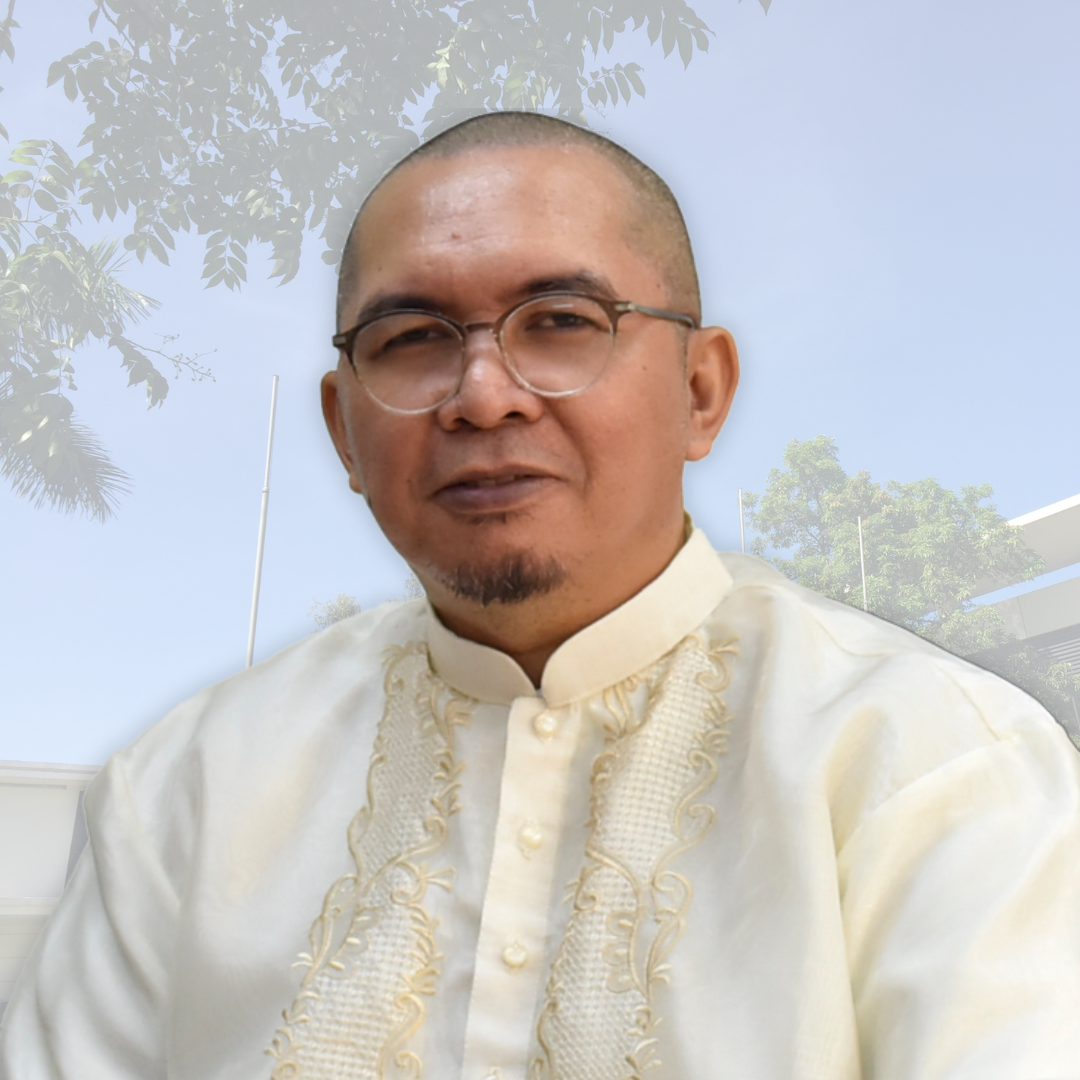
Dr. Noel Christian A. Moratilla is the Dean and a Professor at the Asian Center, University of the Philippines Diliman. He earned his Ph.D. in Philippine Studies in 2015, after completing an MA in Education from the same university. Before he was appointed Dean, he served as Deputy Director of the UP System Office of International Linkages. He is an advocate for the rights of Filipino migrant workers and promotes the alignment of internationalization initiatives with national priorities. Dr. Moratilla's academic interests lie in resistance literature, Marxist and postcolonial theory, testimonial narratives, and diaspora studies.
Un-Forgetting Yaeko: The Japanese Studies Dilemma of Japan and Southeast Asia
Yaeko Yamamura (1899-1996), was a Japanese woman who collected shellfish and birds in Basilan in the Philippines from the Taisho period to the Showa period. She donated more than a thousand and seven hundred shell specimens to the National Museum of Natural Science in Tsukuba City, Ibaraki Prefecture. During her stay in the Philippines, her family was known to have deep ties with the soon-to-be Independent government of President Manuel Quezon. Despite being such an impressive person, she is neither in Japanese nor Philippine histories. In Philippine history, the Japanese are often remembered for their awful deeds during the occupation in World War II, and are usually treated with suspicion. Within Japanese history, despite her contributions to the sciences, her gender and the location of her site has made her invisible. Yaeko Yamamura is a different and important connection between the Philippines and Japan that can engage both countries in a new conversation regarding each other’s history. Rather than use the term “remembering” which is to recall known information, this study uses the term “un-forgetting” as the history is perceived as something suppressed, or forgotten. Such conversations can then lead to larger conversations particularly in relationship to Southeast Asia on what else needs to be un-forgotten.
KARL IAN CHENG CHUA, Ph.D.
Assistant Professor, Asian Center, UP Diliman
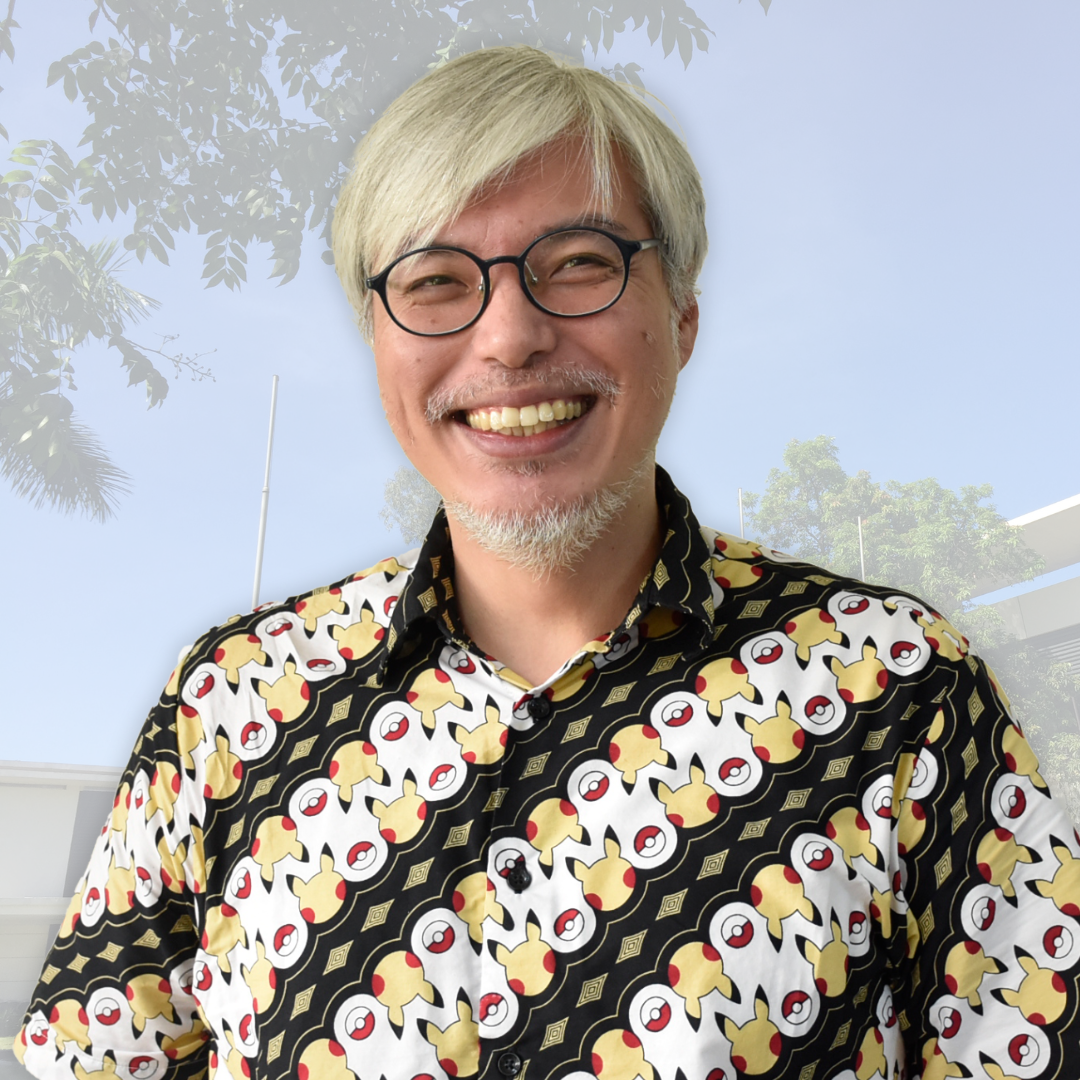
Karl Ian Cheng Chua, Ph.D. is an Assistant Professor at the Asian Center, University of the Philippines Diliman. He served a Professorial Lecturer at the UP Asian Center. He has recently completed his posting as a visiting professor at the Graduate School of Social Sciences, Hitotsubashi University. He serves on the editorial boards of the East Asian Journal of Popular Culture, Comics Studies: Aesthetics, Histories, and Practices, and is Editor-in-Chief of Social Science Diliman.